Crispy fried goat’s cheese salad with pea shoots and honey dressing
Food festivals: the middle-aged glutton’s answer to clubbing.
My kids relish being dragged along to them; they know that mumma turns into a woman possessed and if they endure the endless traipsing and tasting, she’ll say yes to almost any tasty goody they request.
“Ready to put on some kilos?”, my 8-year-old asked sagely on Sunday as we prepared to battle the crowds at the Christchurch Food Festival . He and Girl Child had rather enjoyed the Dorset Knob Throwing and Frome Valley Food Festival earlier in the month where, in between tossing stale bread rolls in a sunny field, we all enjoyed some merry feasting care of lots of small, independent producers.
Christchurch Food Festival is a different kettle of home-made jam. Big-name brands snuggle up to small producers and the involvement of Saturday Kitchen’s James Martin is touted as The Big Draw (go figure). It has a slightly corporate air (why allow a slimming company (for christ’s sake) to pitch up near a fudge stall?) which maybe accounts for the fact that some small producers complain it’s becoming too expensive to attend. But generally speaking, the festival is a good laugh and there are loads of good stuff to eat.
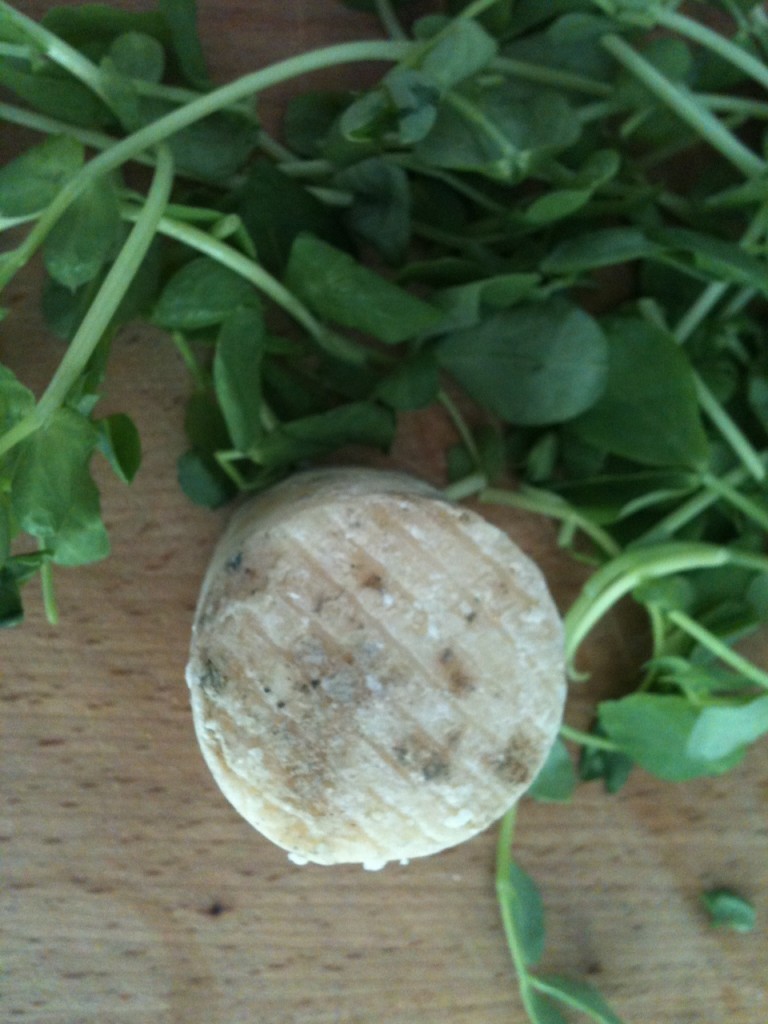
My discovery of the day was East Sussex goat’s cheese producer Nut Knowle Farm. This family-run business has been producing hand-made pasteurized goat’s cheese in East Sussex for more than 30 years. One of my prizes was a single little cylinder of Wealden, a hard Crottin-style cheese, prettily mouldy on the outside - mature, strong and delicious on the inside.
It had been perfuming the contents of my fridge for a few days while I waited for a lull in the workload so I could sit and indulge in some mindful eating. What I had in mind was one of those delicious warm goat’s cheese salads so ubiquitous in French bistros but apparently passé this side of La Manche. This is a naughty version: I’ve double coated the little disks of cheese in egg dip and panko bread crumbs for a really crispy crust - the panko makes this particularly crunchy. The cheese I used was seriously strong; if you do me the honour of trying this recipe please try to find something equally robust as the honey dressing works so well with it.
I’ve discovered that my local Co-op keeps a constant stock of pea-shoots, currently my favourite green leaf. It’s pleasingly sweet and gentle taste is much nicer with this dish than punchy rocket.
Crispy fried goat’s cheese with pea shoot salad and warm honey dressing
- 6 tablespoons olive oil
- 3 tablespoons floral honey
- 1 tablespoon lemon juice
- salt and pepper
- 60g strong Crottin-style cheese
- 1 egg, beaten
- 2 tablespoons flour
- 1 cup panko breadcrumbs
- vegetable oil, for frying
- a handful of pea shoots
- a handful of toasted walnuts
1. Start by making the dressing: whisk together the olive oil, honey, lemon juice and seasoning. Set aside. Place the pea shoots in the shallow bowl in which you plan o serve the dish.
2. Carefully cut the cheese into four disks about 1cm wide. Place the egg, flour and breadcrumbs in separate shallow bowls and dip each disk first into the flour, then the egg and then the breadcrumbs. For an extra crunchy crust dip again in the egg and the breadcrumbs.
3. Heat about 1cm vegetable oil in a large frying pan until smoking (toss a bit of panko in to check the heat - if it instantly sizzles and turns brown the oil is hot enough). Fry the cheese until golden on both sides, then reduce the heat a little and cook for a minute or more. If you are using a hard cheese the inside will soften but it is not meant to melt.
4. Briefly transfer the cheese to a plate lined with kitchen roll, then arrange on top of the pea shoots. Scatter with the toasted walnuts and generously spoon over the dressing. Keep the rest of the dressing in a little bowl beside you as you eat in case you need some more.
Whisky a-go-go
I’m not one of those urbanites who moves out of the big city only to complain that there’s nowhere to buy Jamón Ibérico at 11 o’clock at night. But having relocated from London to the south coast a few years back, the fact was that our local high street lacked, let’s say, some of life’s little niceties.
When we arrived, the shops in Southbourne, a beach-side suburb of Bournemouth, were perfectly lovely, with two butchers, a greengrocer, a bakery, a pie shop and a health food shop. You could also buy a pig’s ear for your dog (two pet shops), a 3cm-high dining suite (the doll’s house shop) and a pouch of pipe ‘baccy (the pipe shop. Really.) But when it came to a decent cup of coffee or a really delicious meal, the pickings were dismally slim. And then things suddenly changed.
The Larderhouse came along selling exceptional coffee and quirky, high-quality artisan food that didn’t fit into any of the conventional restaurant categories. I’ve consumed variously bone marrow pizza, platters of cheese and charcuterie, a whole Dorset ham hock, jaffles cooked in the wood fired oven, carrot cake and a fine selection of sherry, and in time plan to chew my way through the rest of the menu. In the early days, some locals were a bit baffled. But these guys are so committed to what they do that it didn’t take them long to win a dedicated foodie following. And so I found myself at The Larderhouse downing large quantities of fine malt whisky on a school night.
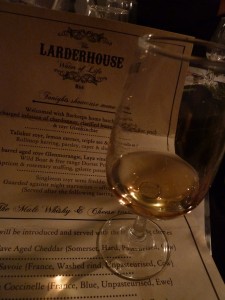 The Single Malt Whisky and Cheese Showcase was the latest in a series of special evenings dedicated to a particular ingredient or tipple (offal, port, sherry); they devise a menu, invite a guest speaker, and there’s general gorging and drinking in a buzzy, clubby atmosphere. Here’s what was on the menu (viewed through the whisky-induced postbox setting on my camera - what’s that about!?!)
For starters, we drank a cocktail of 10-year-old Talisker, lemon extract, triple sec and vanilla. In black and white on the menu it seemed an unlikely partner for rollmops with parsley, caper and shallot salad. Not so - this was one of the cleverest liaisons of the evening.
With our main course we drank home barrel aged 10 year Glenmorangie, Laya vino tinto and fruit shrubb. This was served with a duo of wild boar and free range Dorset pork, apricot and rosemary stuffing and galette potato. I forgot to ask how long this pork was cooked but it was tender as.
The part of the evening I had been dreading was the malt whisky and cheese tasting as I wasn’t sure how to imbibe another four shots and remain upright, let alone work the next day. Copious water and demurring to offers of a refill got me through an amazing tasting. Out with port and cheese, I say, and in with whisky and cheese.
Pudding was a semi-freddo made with a splosh of 12-year-old Singleton, served in a tumbler and covered with a chocolate carapace. A pot of warm horlicks was served alongside to pour over. I always prefer a bit of pastry or crumb where my pudding’s involved, but it was lovely and my husband thought it a very fine thing.
Since The Larderhouse opened, several other foodie joints have opened along the high street, so I have much to be grateful for. What I especially like about this place is that they don’t compromise what they do to please everyone. Every high street should have one.
An ode to porridge
Porridge purists should look away now as it probably constitutes oatmeal high treason to tinker with a national treasure. I do, honestly, enjoy porridge in its purest form: slowly stirred to creaminess with just a pinch of salt, topped with brown sugar or golden syrup and milk. That’s the way my grandmother made it for me as a child, and I still like to cook it her way - a bit thicker than sophistication allows, so it spins like an oatmeal island in a milky lake.
But at the risk of being clonked with a spurtle by the porridge police, I felt the urge this grey old January day to have a bit of fun with grey old porridge. It wasn’t so much the basic porridge I wanted to play with, I just wanted to add some sparkle to it.
Porridge oats come in a range of varieties, all of which produce a different final texture. I won’t go into the detail here, because Sybil Kapoor explained it beautifully in the Guardian a while back for those who want details on oats in all its manifestations. Neither will I pronounce on basic porridge making. Felicity Cloake tested a range of methods before coming up with her own rather lovely way to cook it.
All I will say is that my husband favours cooking the oats in half water, half milk because the result is so voluptuous, but that’s too much for me of a morning. If simmered slowly to allow the starch to do its thing (about 20 minutes I reckon), and stirred constantly, cooking oats in just water is just fine. I use a ratio of one cup oats to two-and-a-half cups water - which might appear an unnecessary quantity of liquid at first - but delivers perfect creaminess if simmered slowly. And it’s surprising how far its stretches - one cup of oats is ample to get four of us breakfasted.
I started this exercise not with porridge porridge, but rice porridge. I’d read of a version eaten in Finland at Christmas, and it sounded too decadent not to try. I melted a knob of butter in a saucepan, and stirred in 1 cup of risotto rice, then added hot milk gradually (with a spoon of sugar added to the milk pan help the flavour along) just as you would with stock. I stirred constantly for about 20 minutes until the rice was just so.
Girl Child and I sat down to eat this with a splodge of damson jam and a splosh of milk on top, and my goodness me. As well as looking pretty as a picture, it was creamy divine. Don’t do what Girl Child did and add too much jam, as this is a very rich breakfast indeed. In fact, it’s probably more a pudding than a meal to set you up for the day, but hey.
The Bircher porridge I made next was a much more virtuous beast. Bircher muesli is one of my favourite breakfasts because I can’t seem to get enough of the taste of raw soaked oats. Among the gazillion words written about matters porridge on the internet, I’d noticed that some people toast their oats with a little butter before simmering. I can now report that this is a pretty good trick and imparts quite a nutty flavour - but do watch that the oats don’t catch in the frying pan.
Bircher porridge
- Knob of butter
- 1 cup porridge oats
- 2.5 cups water
- 1 apple, chopped into small dice
- 1 pear, grated
- 2 tablespoons golden syrup
- small handful nuts (not hazelnuts as they’re overpowering here)
- small handful cranberries or other dried fruit
- small handful mixed seeds
Melt the butter in a frying pan, add the oats and stir well. Toss over a medium heat until fragrant - this should take no longer than a couple of minutes. Bring the water to the boil in a saucepan, add the toasted oats and lower the heat. Simmer very gently, stirring constantly, until the porridge is thick but not yet completely tender, about 15 minutes. Add the diced apple and continue stirring for a further 5 minutes, or until the oats are cooked through. Remove from the heat and mix in the remaining ingredients. Let the porridge stand for five minutes before serving with fresh fruit and milk.
Next up was banana, pecan and maple syrup porridge, which seems to be heading back in the direction of pudding, I know. But then again it’s no more of a dessert than muesli is. This one doesn’t really need a recipe. Just toss a handful of pecans with a couple of tablespoons of maple syrup and a pinch of cinnamon and nutmeg. Spread out on a baking try lined with parchment and toast in a medium oven for about 8 minutes, or until the syrup has begun to caramelize, the nuts are toasted and you can smells deliciousness coming from the oven. Meanwhile, cook your porridge, adding a finely chopped banana halfway through. When the porridge is cooked, stir through the toasted pecans and serve with an extra swirl of maple syrup and some extra fruit if you like.
I was in two minds whether to include this final version or not. Let’s just say I drew the curtains, locked the doors and tried it out in private so I coud be sure no-one was looking. I’m not sure if I would cook this often, but the nuts and dried fruit make this actually quite delicious.
Cook the porridge as you normally would, then remove from the heat and add 60g blanched almonds that you have lightly toasted in a pan, 50g of grated plain chocolate (dark chocolate is too bitter here) and a handful of dried cranberries. Stir through until the chocolate is melted and incorporated.
Top with milk and enjoy joyfully, behind closed doors if you feel guilty.
Top 10 uses for pomegranate molasses
I’d noticed this bottle staring at me every time I opened the refrigerator door, giving me the evil eye from its place among the other neglected jarred stuff. Pomegranate molasses. As common as muck for those who live in chichi parts, but for me a prize obtained after considerable effort on a visit to the big smoke.
 I had wanted this ruby-red, sweet-but-tart syrup specifically for Yotam Ottolenghi’s divine burnt aubergine with tahini and pomegranate, to serve with slow-roasted lamb. My guests fair licked the bowl clean, but with no plans to cook it again immediately, I had little idea what to do with the rest of the bottle. So being a no-waste zealot at the moment, I looked for some other uses for pomegranate molasses before it wound up on fridge death row.
So here you have it, Top 10 uses for pomegranate molasses. Note that I developed and cooked the first recipe but the others are untested ideas I’ve stumbled on, although they all look like pretty good bets to me.
1. Roast chicken with pomegranate molasses glaze
In a small bowl mix together 20ml pomegranate molasses, 1 teaspoon sumac, two minced garlic cloves, a squeeze of lemon, a large splosh of chilli oil and lots of salt and pepper. Mix well. Pat dry a whole chicken and prick the skin all over with a fork. Rub the pomegranate molasses mixture all over the bird and try to get a couple of teaspoons inside the pocket between the skin and breast. Place half a lemon and some fresh coriander inside the cavity, and roast the bird as per your normal method (for me that’s about 1 hour in a 190° oven, or longer depending on the size of the chicken). The skin will turn a deep mahogany and you may feel the need to cover with foil towards the end of roasting to stop it over-caramelizing.
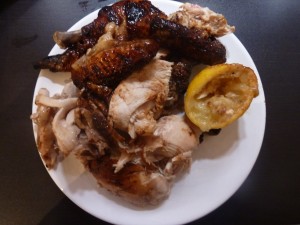
Roast chicken with pomegranate molasses glaze
The resulting bird is incredibly juicy and received a unanimous thumbs up in our house. Some sweet potato roasted alongside the chicken was also enhanced by its proximity to the glaze. Despite the intense taste of pomegranate molasses straight from the spoon, cooked this way its attributes are more subtle. For that reason you won’t be pushing your luck if you also add a teaspoon of it to the roasting pan juices when making the gravy. This recipe also works really well with lamb, pork, duck, game or salmon.
2. Drizzle as it is over vanilla or chocolate ice cream.
3. Or combine 120ml of pomegranate molasses in a small pan with 90g grated dark chocolate and melt together over a low heat. This would be lovely spooned over ice cream or poached fruit. You could go the whole hog and add double to cream to make a ganache for a fabulously rich chocolate cake. Try this one for inspiration.
4. Add a teaspoonful to gin and tonic, a glass of champagne or soda water.
5. Whisk a spoonful into a basic vinaigrette and spoon over a dish like fig and prosciutto salad, or to add sparkle to a salad of mixed green leaves and herbs.
6. Add to cream cheese icing to jazz up plain cupcakes.
7. Stir a tablespoon or two through a stew, braise, tagine, chilli or soup to add an instant depth of flavour.
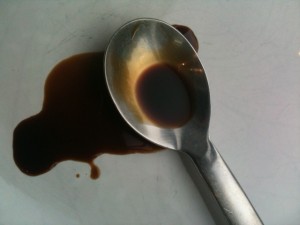 8. Swirl through the basic egg custard when making vanilla ice cream.
9. Blitz together roasted bell peppers, roasted chilli peppers, fresh mint, cucumber, garlic, olive oil, lemon juice and a swirl or pomegranate molasses to make a robust dip to eat with flat bread.
10. Add a slurp to your favourite onion relish recipe or use this version from New York deli Dean & Deluca.
Next stop, Top 10 uses for half-used jars of preserved lemon, bacon fat, piccolo peppers, pickled eggs, …..